Showing posts with label celebrity. Show all posts

Do You Need Life Rights Agreement if Subject is Deceased?

Dear Rich: Do you need to get a release or life rights agreement from the heirs of a deceased person to make a film about or a film including him/her? If a person could be considered a "public figure," does that make a difference? We're not sure what you mean when you say that your film would "include" the deceased person but if the subject of your biopic or documentary is a deceased public figure, you won't need a life rights agreement. A "life rights" agreement is really a way to block three types of lawsuits from happening: violations of privacy, publicity or defamation. (These agreements may also involve "cooperation" arrangements requiring a living person to cooperate with the filmmakers.) A deceased person has no privacy rights and cannot be defamed. In some states the right of publicity survives death, but documentaries and biopics typically don't trigger these rights -- unlike the sale of merchandise or endorsement of products, for example. Of course, there may still be a need for permissions for copyrighted materials such as photos, music rights --for example in the case of a biopic about a musician, or rights based on a published work such as a biography.
When do you need them?  Life rights agreements are most often needed if liberties will be taken with the facts about a living person, or if the person is not a public figure. Public figures cannot stop a life story documentary or biopic in the U.S. if there are no violations of privacy or defamation ... although they can always threaten lawsuits.  Check out our previous entry on life rights. (BTW, this site explains the life rights rules.)


Will We Get in Trouble for Sports Celebrity Prints?

Dear Rich: Can an artist sell to the public prints from paintings done of famous sport celebrities for profit in California and other places. He was told an artist's 'first amendment publicity' or something like that trumps the rights of the famous person. This artist doesn't seem to be concerned at all but he's a good friend and not in good health and if something happened and if he was drug into court, he'd likely die from the stress and embarrassment to his career (even if he won). Shall I try and stop him? He says if there is a problem he'll simply just stop immediately. I'm worried about him. We think that what your artist friend was told was that "an artist's first amendment right trumps a sports celebrity's right of publicity," a maxim that oversimplifies a complex issue. The right of publicity allows every person to control the use of their name or persona for commercial purposes -- typically on a product (like our Tiger Woods golf ball). However, celebrities cannot control so-called informational or "communicative" (first amendment) uses -- for example, articles, books, or documentaries.
What about the gray areas? Things get tricky at the intersection of communicative and commercial uses -- such as limited edition art prints. In that situation, a ten-year old Ohio ruling favors your friend. An artist painted Tiger Woods at the Masters Tournament and later sold more than 5000 prints of the image superimposed with other great golfers. (Here are some details on the artwork). A federal court of appeals ruled that the sale did not violate Tiger's right of publicity. A related ruling regarding paintings of the University of Alabama's football team -- though it dealt more with trademarks than the right of publicity -- also was in favor of the artist. Both of these cases took years and a great deal of attorney time and fees to decide. So, although the law may be on the side of your friend, that doesn't mean he can't be dragged into court to defend his rights.
No copyright infringement. Also, we're assuming that the prints being sold are made from your artist friend's original paintings. If the paintings are by another artist, or if they are based on a photographer's original photos, then your friend could be hassled for claims of copyright infringement by the original artist or photographer respectively.

Can We Pilfer Celebrity Photos From IMDB?

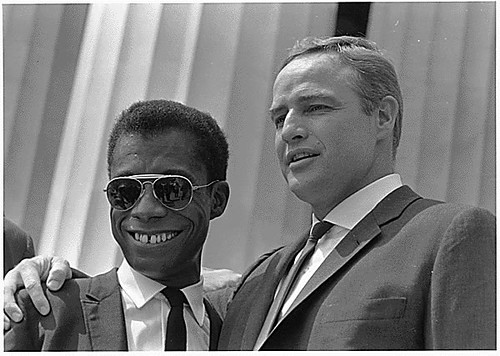
Marlon Brando and James Baldwin
at 1963 March on Washington
Dear Rich: I wanted to post some photos for a celebrity article at my website. I’ve totally forgotten rules regarding photos. Can I pilfer IMDB and give an attribute to them or do I actually need their permission? Are there any secret public domain photos for celebs you know about? The copyright in celebrity photos is owned by the photographer (or by the agency to whom the photographer has transferred rights). We doubt whether the IMDB owns rights in all the photos it posts. Most likely, it's acquired those rights from the copyright holders. Often large celebrity-styled sites have ongoing 'subscription' deals with the companies that own photo rights such as Getty Images, PR Photos, PictureLux, and Shutterstock.
Operating without clearance. If you work for a website company, you're best off not jeopardizing your job by using unauthorized photos. The price you'll have to pay -- time, threats, lawsuits and payments -- if you're caught will far outweigh the licensing costs. If you're just posting a photo occasionally to your personal blog, you're less likely to get hassled but beware that photo agencies employ various means of tracking digital photo use including digital watermarks and embedded metadata.
Right of publicity. The rules we provide here are for websites where you are using the celebrity photo as a means of illustrating a story about the celebrity -- for example, you're discussing the funny side of Mike Tyson. If you are using the celebrity photo to imply endorsement of your site or to sell a product or service, you'll need the celebrity's permission as well.
Public domain photos. There are some public domain photos of celebrities. Try sites such as Wikimedia and read and observe the terms of the licenses. We're not so sure about so-called public domain photos at other sites -- that is, whether the photos are actually in the public domain. We typed in "public domain celebrity photos" and found mixed results (including pictures of Dwight Eisenhower and Britney Spears -- we don't want to think about the potential mash-up!). Of course photos taken by government employees -- for example, Elvis shaking hands with President Nixon (soon to be a movie) are in the PD. We think that's the case with our photo of Marlon Brando and James Baldwin (above) -- perhaps taken by an FBI agent. (And here's a related video made around the same time).