Dear Rich: I'm a budding photographer with a passion for graffiti and mural art. I photograph it whenever I travel and here at home in Philadelphia. Many of the images I've captured no longer exist, but some do. One of my photos, taken recently in the Mission District of San Francisco has generated some controversy. A man who claims to be the artist contacted me today to say that I am selling illegal reproductions of his copyrighted work. He wants me to remove them immediately. He claims to own "the intellectual and copyright rights to" the murals. I did some research before posting the images to my Etsy shop and came to the conclusion that the graffiti was public property, like the much photographed LOVE statue in Philly or the Eiffel Tower. I definitely want to do the right thing -- my main incentive for photographing the work is to preserve and protect it -- regardless, I'd really appreciate your advice. Assuming that the person claiming copyright can verify ownership, we think you should remove the photos. Your two examples of "public art" -- the Eiffel Tower in Paris and the LOVE sculpture in Philadelphia -- aren't really applicable to the mural situation. The Eiffel Tower is a public architectural monument that can't be protected under copyright law. As we mentioned in a previous entry, shooting and reselling publicly visible architecture is almost always permitted. As for the LOVE sculpture by artist Robert Indiana, that is not protected under copyright law because the Copyright Office apparently refused to register the work, claiming that the law does not protect single words. Typically, however, public murals and sculptures are protected by copyright law.
Why you should take it down. We talked about the rights of mural artists in a previous entry and explained how mural artists are protected not just by copyright law, but also by some state art laws. Merely creating the mural doesn't mean that the complainer owns the copyright -- the mural may have been a work made for hire or the copyright may have been assigned. Chances are good, however, that if he's complaining, he's the owner -- why else hassle you? The copyright owner could file a DMCA complaint with Etsy (or Etsy's ISP) or could sue you (or both). If you can make this situation go away by just removing the offending photos, that would be the most efficient course of action.
Home » Posts filed under photography
Showing posts with label photography. Show all posts
Does Architect Own Copyright in Building Photos?
Dear Rich: I have an architectural practice and have posted the photographs of a number of completed projects on a web site called Houzz. Now, a past client has seen my photos of her project and is demanding that I remove them. There was no clause in our contract either way, although I'm certain that case law has established that the rights to the architectural design and drawings remains with me, the professional who created them. But what about images of the completed project? Thanks for the link to Houzz.com, where we spent several hours deciding whether we liked our home office (photo) better than the posted ones (we did).
Right, you had a question. Image copyrights are owned by the person who created the image - the photographer. If the image contains separately copyrightable material--for example, there's artwork within the image, or the architectural design is copyrightable -- then permission is required from the photographer and the artist or architect whose work appears in the photo. There are many exceptions to these rules, for example, if the exterior is publicly viewable or the reproduction qualifies as a fair use. We wrote about many of these issues in this post on architectural photos. The only other issues that might arise would be contractual (did you agree not to post images?) or privacy (did you invade the client's privacy in some way by posting the images?). Assuming these are standard interior shots without client identification (as commonly seen on Houzz), we doubt that the latter issue will arise.
Can I Photo Miami Landmarks?
Dear Rich: I am a professional photographer that recently moved away from fashion and commercial photography to artistic photography. Currently I have a show in Florida composed of highly manipulated images of several structures among them the notable Miami’s 1111 Lincoln Road parking lot. The property managers have recently sent me letters claiming I have infringed on their copyright, trademark and patent rights. What do you think? We don't understand why property owners are hassling you. But then again, we don't understand a lot of things -- for example, why people are stealing Tide to buy crack, why so many people were taking their clothes off on the most recent episode of Girls, or why things ended so badly for Paul Masson wines and Orson Welles.
Right, you had a question. We've said it before in other blog entries, but we're happy to repeat it here: Anyone is free to photograph publicly viewable buildings in the U.S., (even those constructed after architectural copyrights were legitimized). Under copyright law, building owners cannot prevent you from taking photos from a public spot and they can't hassle you over manipulations or other "pictorial representations." As for hassling you over patents, that's a non-starter. The design and appearance of a building can't be protected by a utility patent. Arguably, it may be protected by a design patent but that could only be infringed if someone created a similar building. As for trademark protection, it's possible that uniquely shaped structures such as the 1111 Lincoln Road parking lot may claim trademark rights (we found a registration for the mark, "1111," Serial No. 77816143) but even if the parking lot achieved trademark/trade dress status, the owners can't stop artistic or editorial uses such as a photo exhibition, or a book from an exhibition (or even for use on postcards).
Can I Use Photo of '54 Buick?
Dear Rich: I recently went to a public event that included an antique car show. There were no restrictions about photography. I shot many images of many cars. I handed out my card to the car owners when I could find them and told them they could see some of the photos on my web site and purchase them too. Many of my photos are just detail shots, using the shapes, forms and color to make an interesting composition. A week after the show, I get an email from the owner of a 54 Buick asking me to please remove the photograph of his car from my web site. He said I did not tell him I was a company selling photographs. I must not have told him they could be purchased. It was only then that I learned of the “property release” issue. I was dumbfounded and naïve to this but it just didn’t seem right. The photo in question is not even the whole car, it could be any 54 Buick. But even if it’s the whole car, what’s my risk? We can only think of a few situations where you might be at risk: (1) if the cars contained artsy creative custom detail work that amounted to separate artistic expression (in which case there may be a copyright claim); or (2) if the organization that presented the custom car show placed restrictions on photography (in which case you would have breached the contract and the organization -- not the car owner -- would have a claim); or (3) the focus of your work was car logos and you sold these images on merchandise -- for example, selling t-shirts with the Chevrolet logo (in which case, the car company -- not the car owner -- might bring a trademark claim). Otherwise, we don't see a problem.
What about the property release? A property release is typically used to allow someone permission to enter property (typically, a house or building) and use the location in a photo or film. A property release wouldn't be required at an auto show show (unless the venue had photo restrictions).
Copyright in Glass Negatives
Dear Rich: My great grandfather was among other things a photographer in the late 1800's. We have some of his original glass plate negatives which have never been out of the family's possession. At this time we are considering printing limited edition prints of some of the images. Since we own the negatives can we copyright them? If your great-grandfather died before 1942, and the photos were never published, they are in the public domain. (A photo is "published" when copies are distributed to the public by sale or some other ownership transfer.) If you don't know the year he died, your great-grandfather's unpublished photos are protected for 120 years from creation (that is, anything created before 1892 is public domain).
Publication. If the photos were published, the rules vary depending on the date of publication and whether the work had to be renewed. You can explore all of these possibilities using this public domain chart.
Exploiting the negatives. We hope you can share and enjoy the negatives in some way. It's true that a few glass negative discoveries bring about a jackpot, but, alas, most glass negatives aren't worth dragging to Antiques Road Show (although they may have some historical value).
Publication. If the photos were published, the rules vary depending on the date of publication and whether the work had to be renewed. You can explore all of these possibilities using this public domain chart.
Exploiting the negatives. We hope you can share and enjoy the negatives in some way. It's true that a few glass negative discoveries bring about a jackpot, but, alas, most glass negatives aren't worth dragging to Antiques Road Show (although they may have some historical value).
Can Terms of Use Limit Public Domain Reproduction?
| London Street Fiddler 1880 |
"Many copyright experts believe that licenses imposing copyright-like restriction on how the public may use public domain materials should be legally unenforceable. This is because the federal copyright law prevents people from using contracts to create their own private copyrights. However, almost all courts have ignored the experts and enforced these licenses."
Wants to Copyright Public Domain Photos
| Mrs. Tibitts (circa 1860) |
Longer answer (1) Once something's fallen in the public domain as a result of old age (as has all photography published in the U.S. before 1923), it cannot be reclaimed. If you modify a public domain work -- add additional imagery, unique coloration, or anything else arty -- you can claim your combination of old and new. But you will never be able to stop someone from reproducing the underlying public domain image with one possible exception. If you use a public domain image as your product's trademark, you may be able to stop competitors from using the same image on similar goods under trademark law.
Longer answer (2) It doesn't matter if someone "discovers" a public domain work and publishes it at their blog. If it's public domain, anyone can reproduce it. For more on the public domain, check out Steve Fishman's excellent book.
Realtor Wants to Assign Photo Rights
Dear Rich: I’m a Realtor and I take hundreds of photos of my listings every year and write the copy for publication. I compile the information that is then used by our local multiple listing service. I am being approached by multiple vendors I do business with wanting me to give them my copyrights to my photos and text. Is there a copyright that will cover my work as whole, both existing and future listings, without my having to file a separate copyright for each listing’s photos and text? Just so we're clear ... You take the photos of the properties and as photographer, you own the copyright in each photo. Certain vendors want permission to use the photos, is that right? Or do they want to own all rights to the photos?
If the vendors just want copyright permission ... In that case, you can write a statement to the effect that "I own copyrights in all photos that I furnish to you and I grant you permission to reproduce the photos for your [name of site or publication] and I retain all other rights." (You can find more nuanced language in our Getting Permission book.) A license allows you to retain copyright and permits the other party to use the photos. We'd recommend that you seek a license rather than assign your rights (this article explains the difference).
If they want to own all rights ... In that case, you need to assign your rights in each photo. When you do that, you won't retain anything. You would do that with a statement with each photo or batch of photos that you furnish. It would be something to the effect of "I assign all copyright in the following photos: [list the photos by the property addresses] to you." Of course you might want something a little more formal. This statement can be by email as long as you follow the rules shown here. If you assign, you can't reproduce the images yourself unless you get permission from the new owner.
Do you need to file a copyright application? No. Copyright is automatic in the U.S. and you get it once you click the shutter on your camera. Registration, though recommended, is a formality that provides certain legal benefits. You don't have to register copyright to license or assign your rights.
If the vendors just want copyright permission ... In that case, you can write a statement to the effect that "I own copyrights in all photos that I furnish to you and I grant you permission to reproduce the photos for your [name of site or publication] and I retain all other rights." (You can find more nuanced language in our Getting Permission book.) A license allows you to retain copyright and permits the other party to use the photos. We'd recommend that you seek a license rather than assign your rights (this article explains the difference).
If they want to own all rights ... In that case, you need to assign your rights in each photo. When you do that, you won't retain anything. You would do that with a statement with each photo or batch of photos that you furnish. It would be something to the effect of "I assign all copyright in the following photos: [list the photos by the property addresses] to you." Of course you might want something a little more formal. This statement can be by email as long as you follow the rules shown here. If you assign, you can't reproduce the images yourself unless you get permission from the new owner.
Do you need to file a copyright application? No. Copyright is automatic in the U.S. and you get it once you click the shutter on your camera. Registration, though recommended, is a formality that provides certain legal benefits. You don't have to register copyright to license or assign your rights.
"Revising" Photographs: When Is it Fair Use?
Dear Rich: I am writing in concern of my use of already existing photographs as a source for my artwork. As a print maker, at times, I base my work on the photographs of others. Sometimes I am able to gain permission from the creator of the photograph and other times I have no luck with the correspondence at all. For the work itself I build a theme around a source photograph. From that photograph I cut a stencil that re-creates the image in a graphic way. The finished product may be recognizable to it's original source but is not a direct replication. I make a very limited run of my final work ranging from 1-23 pieces. Some of the work is produced for gallery shows, murals, or to be sold as prints. Sometimes the work finds it's way into a book documenting art. So my question is where is the line drawn between fair use/transformative use and copyright infringement for images? Asking the Dear Rich Staff to define the line between fair use and infringement is a little like us asking us to define the line between art and nature. We can define fair use (and we've done so at this site) and you can review caselaw and look for comparative fact patterns. But in the end, to paraphrase Marshall McLuhan, fair use is anything you can get away with (P.S. we love MM. Can you believe he wrote this 45 years ago?). Fighting over a fair use claim comes down to a lot of time spent with lawyers and -- as in the recent Richard Prince case -- the outcomes are not always favorable to artists.
Won't Pay for Photos: Can We Demand Takedown?
Right, you had a question. You may consider this as bad news, but -- assuming you have entered into an enforceable contract with the customer -- it would be improper for you to ask the retailer to remove the photos. You could only do that if the use was unauthorized. In this case, the use apparently was authorized -- you just haven't been paid for it. If the contract was fraudulently induced and the contract was rescinded (as explained in this case), you could proceed as an infringement action. But it's usually much more difficult to prove fraudulent inducement (the other party never intended to pay you) than to prove contract breach (the other party delayed paying you). Typically, in situations such as yours (and in this case and this case), your remedy is to sue the customer for breach of contract. That may sound wrong to you. After all, if you haven't been paid how can they use your images? So what's a photographer to do?
Some options. The gang over at PhotoAttorney state that it's possible to insert language into a contract that would permit an infringement lawsuit if payment is not received. The language indicates that no rights can be exercised until payment is received and that any such uses will be considered willful infringements. (The crew at ASMP supports a similar position.) We think the provision could be improved by adding a statement to the effect that, "In the event that rights are granted prior to payment to photographer, this contract shall be automatically rescinded." We can't guarantee the enforceability of the provision (because a court is the ultimate authority on whether a contract is rescinded), but it should come closer to meeting the standards explained in the cases cited above. BTW, you may want to check out our answer to a similar photo question.
Can Photographer Control Photos From Fashion Shoot?
Dear Sir/Madam: I am a freelance photographer and I am also working on an upcoming online fashion magazine. Recently I organized a photo shoot with a few models I have founded via Internet and a designer who agreed for the models to wear his clothes for the photo shoot purposes. The designer refurbishes and sells branded clothes. Everyone agreed to the photo shoot on these terms:
- Everyone gets the photos for their own usage
- I will use the pictures however I want, and also the ones I choose will be featured in the online magazine
- No fees charged on anyone including models, designer and myself
Right, you had a question. Unless there is a written document evidencing copyright transfer, you, as photographer own copyright in the photos. You control the reproduction and distribution and you're free to choose and reproduce the photos you want for your magazine. If the verbal agreement is enforceable -- that depends whether there is sufficient evidence to prove the terms and conditions -- you would have to abide by those terms, as well. Even if the verbal agreement is valid, it doesn't preclude you from doing what you want -- choosing the photos you wish to use in the magazine. (And you would be obligated to provide copies of the photos to the other parties.)
Do you need to mention the designer? We're not sure why you have to mention the designer or the designer's store, unless you're contractually bound to do so. The designer has no copyright in clothing design unless he's stitched in some unique artwork--for example, he's added intricate needlepoints. In any case, it might be a nice professional touch to credit the designer as fashion readers expect that information.
What about model releases? Releases are needed to head off two types of problems: invasion of privacy (you may be invading the model's privacy, for example, by showing her partially nude); or violation of the right of publicity (you're using the model's image to sell something). Typically, editorial non-commercial uses wouldn't trigger the right of publicity but with Google AdSense and similar Internet schemes, it's difficult these days to tell sometimes whether an image is being used for commercial exploitation.
*Serial killers named Richard: Richard Angelo - The Angel of Death, Richard Biegenwald - The Thrill Killer, Richard Chase - The Vampire of Sacramento, Richard Cottingham - The Torso Killer, Richard Macek - The Mad Biter, Richard Ramirez - The Night Stalker (and speaking of notorious killers, there's also Richard Loeb (of Leopold and Loeb infamy).
Can We Pilfer Celebrity Photos From IMDB?
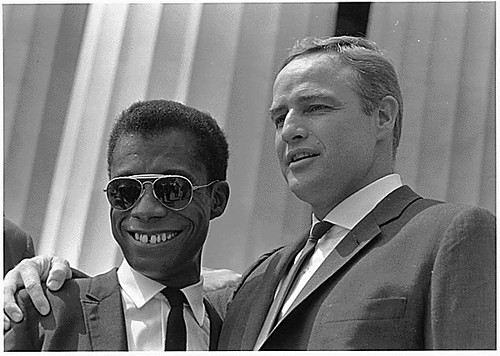
| Marlon Brando and James Baldwin at 1963 March on Washington |
Operating without clearance. If you work for a website company, you're best off not jeopardizing your job by using unauthorized photos. The price you'll have to pay -- time, threats, lawsuits and payments -- if you're caught will far outweigh the licensing costs. If you're just posting a photo occasionally to your personal blog, you're less likely to get hassled but beware that photo agencies employ various means of tracking digital photo use including digital watermarks and embedded metadata.
Right of publicity. The rules we provide here are for websites where you are using the celebrity photo as a means of illustrating a story about the celebrity -- for example, you're discussing the funny side of Mike Tyson. If you are using the celebrity photo to imply endorsement of your site or to sell a product or service, you'll need the celebrity's permission as well.
Public domain photos. There are some public domain photos of celebrities. Try sites such as Wikimedia and read and observe the terms of the licenses. We're not so sure about so-called public domain photos at other sites -- that is, whether the photos are actually in the public domain. We typed in "public domain celebrity photos" and found mixed results (including pictures of Dwight Eisenhower and Britney Spears -- we don't want to think about the potential mash-up!). Of course photos taken by government employees -- for example, Elvis shaking hands with President Nixon (soon to be a movie) are in the PD. We think that's the case with our photo of Marlon Brando and James Baldwin (above) -- perhaps taken by an FBI agent. (And here's a related video made around the same time).
Wants to Use Historical Photos in Book
Dear Rich, I have photos I want to use for a book I am writing. The photos were given to me by the photographers. As far as I know these photographs were never published. They photos were taken in various years including 1914, 1924, and 1965. The photographers are all now deceased. However, the people who gave me the photos were informed that I was writing a book about local history and were going to use the photos for research. Can I use these photos in my book? Do I need to try to contact the descendants of the photographers in order to get permission or can I just credit the source of the photographs? I also want to use a photo I found in a history book. The photo is a pre 1923 portrait of a local man. The caption for the photo reads “Courtesy of William B. Secrest, Fresno, California.” Secrest is the author of the book and owns the original photograph. Do I need to track down William Secrest or can I use the photo without permission since it is pre 1923? The history book was published in 2002. I would of course appropriately cite the photograph. We think you'll be okay to use all of the photos described, but it gets a little complicated.
The 1914, 1924, and 1965 photos. If the photos were never published and the photographers died before 1941, the works are in the public domain (Here's the official explanation). Otherwise, the unpublished photos will not become public domain until the author has been dead for 70 years. (Based on this rule, the 1965 photo could not be in the public domain.) Even though your one or more of your uses is likely to be unauthorized -- and an infringement -- we think that you will have a strong fair use argument, and we also think that the likelihood that the descendants of the photographer will learn of your use (or care) is slim. A commercial publisher may require that you indemnify the publisher if there is a problem. You may want to consult an attorney at that point.
As for the pre-1923 portrait. If the pre-1923 portrait was first published with authorization before 1923 it's in the public domain and you're free to use it. If it was first published after 1922 but before 1964, the photo is in the public domain if it wasn't renewed (and most were not). If the first publication was in 2002, and the author died before 1941, it is also in the public domain. (See, we told you it was complicated). As for the prolific California historian William B. Secrest, we think -- and we could be wrong -- that he owns the photo and lent it for use in the book. The "courtesy" he has extended is that he provided access to the photographic print. Was there a copyright notice associated with the publication in the 2002 book? That could also be indicative, though not decisive as to the photo's copyright status.
The 1914, 1924, and 1965 photos. If the photos were never published and the photographers died before 1941, the works are in the public domain (Here's the official explanation). Otherwise, the unpublished photos will not become public domain until the author has been dead for 70 years. (Based on this rule, the 1965 photo could not be in the public domain.) Even though your one or more of your uses is likely to be unauthorized -- and an infringement -- we think that you will have a strong fair use argument, and we also think that the likelihood that the descendants of the photographer will learn of your use (or care) is slim. A commercial publisher may require that you indemnify the publisher if there is a problem. You may want to consult an attorney at that point.
As for the pre-1923 portrait. If the pre-1923 portrait was first published with authorization before 1923 it's in the public domain and you're free to use it. If it was first published after 1922 but before 1964, the photo is in the public domain if it wasn't renewed (and most were not). If the first publication was in 2002, and the author died before 1941, it is also in the public domain. (See, we told you it was complicated). As for the prolific California historian William B. Secrest, we think -- and we could be wrong -- that he owns the photo and lent it for use in the book. The "courtesy" he has extended is that he provided access to the photographic print. Was there a copyright notice associated with the publication in the 2002 book? That could also be indicative, though not decisive as to the photo's copyright status.
HiJacked and Automatic Photography
Dear Rich: You have no doubt heard about the copyright dispute over the self-portrait taken by a black macaque and photographer David Slater. In a discussion of this story at the Online Photographer it was claimed that copyright law forbids the assignment of copyright to a person in the case of photos that are taken automatically. This would seem to invalidate the copyright of most of the famous strobe photos of Harold Edgerton, for example - though MIT currently claims copyright on his photographs. So what's the scoop on copyright and automatically-taken photographs? Although the photos that you mention all have something in common -- a human did not press the shutter -- their copyright status actually varies depending on factors that we'll discuss below.
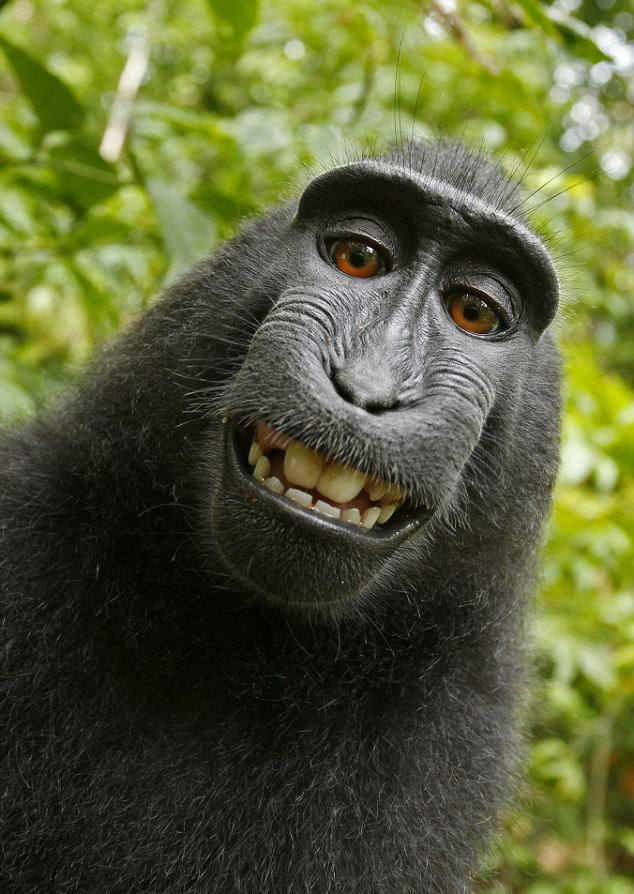
Artwork created by animals. We've followed the careers of various animal artists trained to create paintings and music (Ruby R.I.P.) and we believe that these works cannot be protected under U.S. copyright law. (P.S. for those seeking to invest in elephant art, watch out for the fakes!) According to the U.S. Copyright Office rules, only a human may create a 'work of authorship.' Those same rules prohibit registration of works owing their form solely to forces of nature and without human intervention -- such as driftwood. Although Copyright Office rules don't have the force of law -- the Copyright Act itself does not make these same anti-animal, anti-nature artist pronouncements -- these Copyright Office regulations are commonly accepted by the courts. For that reason, we believe that it would be difficult to (1) acquire a registration in the United States for the macaque self-portraits, and (2) for Slater's so-called assignees to maintain a lawsuit against an alleged infringer.
Photos in which a human did not press the shutter. There's a big difference between a photo taken by an animal and an "automatic," programmed, or computer-generated photo. For example, a photo taken with a timer can be copyrighted by the person who set up the camera and the timer. Similarly, a photo triggered by magnetic fields, or triggered by stroboscopic flashes, can also be copyrighted by the party who programmed the camera. By way of analogy, author Stephen Fishman points out in his "amazing treatise" on the public domain that the Copyright Office has registered hundreds of computer generated musical compositions and even a literary work written by a computer in the style of author Jacqueline Suzanne. In this manner if Slater had set up his camera to capture the "Cindy Sherman of Monkeys" and the shutter was programmed to capture the macaque each time it moved, Slater would arguably maintain copyright even though he was not present when the macaque said 'Cheese.'
Artwork created by animals. We've followed the careers of various animal artists trained to create paintings and music (Ruby R.I.P.) and we believe that these works cannot be protected under U.S. copyright law. (P.S. for those seeking to invest in elephant art, watch out for the fakes!) According to the U.S. Copyright Office rules, only a human may create a 'work of authorship.' Those same rules prohibit registration of works owing their form solely to forces of nature and without human intervention -- such as driftwood. Although Copyright Office rules don't have the force of law -- the Copyright Act itself does not make these same anti-animal, anti-nature artist pronouncements -- these Copyright Office regulations are commonly accepted by the courts. For that reason, we believe that it would be difficult to (1) acquire a registration in the United States for the macaque self-portraits, and (2) for Slater's so-called assignees to maintain a lawsuit against an alleged infringer.
Photos in which a human did not press the shutter. There's a big difference between a photo taken by an animal and an "automatic," programmed, or computer-generated photo. For example, a photo taken with a timer can be copyrighted by the person who set up the camera and the timer. Similarly, a photo triggered by magnetic fields, or triggered by stroboscopic flashes, can also be copyrighted by the party who programmed the camera. By way of analogy, author Stephen Fishman points out in his "amazing treatise" on the public domain that the Copyright Office has registered hundreds of computer generated musical compositions and even a literary work written by a computer in the style of author Jacqueline Suzanne. In this manner if Slater had set up his camera to capture the "Cindy Sherman of Monkeys" and the shutter was programmed to capture the macaque each time it moved, Slater would arguably maintain copyright even though he was not present when the macaque said 'Cheese.'
Are Nonprofits Liable for Photo Infringement?
Dear Rich: I have been collecting black-and-white snapshots at antiques shops and flea markets for several years. This year i started posting some of them with slightly irreverent captions on my website. I think I understand that orphan works produced before 1923 are considered to be in the public domain. But what about the later photos? I haven't been too concerned about copyright violations because it is a nonprofit site. However what if I wanted to reproduce the images for profit? What kind of legal issues would I face? We think you're operating under a few misconceptions so maybe we should clear those up, first.
Nonprofits can be liable for infringement. Being a nonprofit won't shield you from a lawsuit. Nonprofits are occasionally named as defendants -- for example, the Internet Archive was sued over its caching of old web pages (and some nonprofits have filed suits as well). Nonprofit status may affect fair use determinations (as explained here). But in general, it makes little difference for purposes of determining infringement, whether the theft was for profit or not. You should also be aware that nonprofit status is a corporate tax status; a failure to profit doesn't make you a nonprofit.
Orphan works are not public domain. You are correct that works published in the U.S. before 1923 are in the public domain in the U.S. But these are not orphan works. An orphan work is one that is still protected under copyright but whose owner is missing in action and there's nobody to contact for permission. We think that's the case with most of the photos at your website.
Right, you had a question. We think the odds are slim that you will be the subject of a lawsuit. A copyright owner of one of your vintage photos (the owner would be whoever took the picture) is unlikely to see your work, unlikely to threaten a lawsuit and unlikely to recover much if the lawsuit should it actually go to court. So the chances are low that you will be hassled. Still, for the record, these are infringements. There is also a slim possibility that one of the subjects of these photos will see your site and claim an invasion of privacy or (if you sell the images) a violation of the right of publicity. Again, unlikely, but possible ... kind of like guessing whether an earthquake will hit Virginia.
Nonprofits can be liable for infringement. Being a nonprofit won't shield you from a lawsuit. Nonprofits are occasionally named as defendants -- for example, the Internet Archive was sued over its caching of old web pages (and some nonprofits have filed suits as well). Nonprofit status may affect fair use determinations (as explained here). But in general, it makes little difference for purposes of determining infringement, whether the theft was for profit or not. You should also be aware that nonprofit status is a corporate tax status; a failure to profit doesn't make you a nonprofit.
Orphan works are not public domain. You are correct that works published in the U.S. before 1923 are in the public domain in the U.S. But these are not orphan works. An orphan work is one that is still protected under copyright but whose owner is missing in action and there's nobody to contact for permission. We think that's the case with most of the photos at your website.
Right, you had a question. We think the odds are slim that you will be the subject of a lawsuit. A copyright owner of one of your vintage photos (the owner would be whoever took the picture) is unlikely to see your work, unlikely to threaten a lawsuit and unlikely to recover much if the lawsuit should it actually go to court. So the chances are low that you will be hassled. Still, for the record, these are infringements. There is also a slim possibility that one of the subjects of these photos will see your site and claim an invasion of privacy or (if you sell the images) a violation of the right of publicity. Again, unlikely, but possible ... kind of like guessing whether an earthquake will hit Virginia.
Has Roy Orbison Negatives
Dear Rich: I read an article about a man who took pictures of the Beatles when he was a teen and recently sold them. That got me thinking about my 23-year old negatives I have of the singer Roy Orbison and his family. I was working on a Christmas card for the family and shot several rolls of film. A month and a half after the photo shoot Mr. Orbison passed away. As the photographer I had them sign a release and I still maintain the negatives. Question is: Do I have the right to print and market those images? If so, what do I need to market images and how far may I go in creating additional marketable images? OMG! We just realized Roy Orbison has been gone for almost 25 years! It seems like yesterday that the In Dreams star passed away. What has the Dear Rich Staff been doing all these years?
Right, you had a question. The short answer is that you can sell copies of your photographs (prints) and you can license the photos for editorial uses such as books and website articles. But you cannot license them for commercial uses such as product endorsements or merchandise unless such rights were conveyed to you by the people signing the releases (unlikely).
The longer answer. There are three legal principles at work: copyright, contracts, and the right of publicity. Unless the photos were done under an employment relationship, copyright grants the photographer (the person who took the pictures) the right to copy and create derivatives of the photos. The right of publicity allows the subject of the photo to control the way their image is used for endorsements and merchandise. Contracts are used to transfer these rights. So, the photographer retains copyright unless a contract transfers that right and the subject retains the right of publicity unless that right is transferred by contract (for example, a release). For that reason, you will obtain the most reliable answer after someone reviews your photo releases to determine what rights were granted to you.
Right, you had a question. The short answer is that you can sell copies of your photographs (prints) and you can license the photos for editorial uses such as books and website articles. But you cannot license them for commercial uses such as product endorsements or merchandise unless such rights were conveyed to you by the people signing the releases (unlikely).
The longer answer. There are three legal principles at work: copyright, contracts, and the right of publicity. Unless the photos were done under an employment relationship, copyright grants the photographer (the person who took the pictures) the right to copy and create derivatives of the photos. The right of publicity allows the subject of the photo to control the way their image is used for endorsements and merchandise. Contracts are used to transfer these rights. So, the photographer retains copyright unless a contract transfers that right and the subject retains the right of publicity unless that right is transferred by contract (for example, a release). For that reason, you will obtain the most reliable answer after someone reviews your photo releases to determine what rights were granted to you.
Can They Use Photos of Our Home in Magazine?
Dear Rich: We are restoring our home in Atlanta and our architect had asked me near the beginning of the restoration to fill out a questionnaire about the experience of working with him. I did so very positively. The relationship has since cooled a little, and recently we became aware of an article published about us and our home in which my responses were modified and used extensively as direct quotes by the writer as if she had talked to us. We had never talked to the writer or knew anything about the article. Many quotes were attributed to my wife who had never seen the questionnaire. The article also included pictures taken of the home from on our property. And, the writer had us quoting someone from the Historical Society saying something that he never said and that we never said he said. The feature ended with a bold-faced paragraph saying, "Look for an update...in an upcoming issue." We do not want another story done by this publication. Do we have legal rights to prevent them from using photos of our home--interiors and exteriors shot from our property--that are taken by the architect? We assume that the architect instigated the article, so practically we think the best course is to notify him and ask him not to publish any more photos of your home or publish any more statements attributed to you or your wife. We think the letter will work best if it is flat and matter of fact, not harsh, legalish, or argumentative. The prudent response from the architect would be to comply.
The Legal Analysis. In answer to your specific questions, a magazine would need permission from the copyright owner of the photos (the architect, apparently) and would only need a property release for the interior pictures assuming they were taken without the authorization of the homeowners. That may be the case here but it's probably not worth hassling over and it may be difficult to prove without losing money on attorney fees. Exterior photos of your home taken from public locations can be used for editorial purposes without your consent. Using your quotes without permission is probably a violation of copyright law, unless the architect can demonstrate that you consented or that your consent was implied, or there is a fair use defense.
Ennyway ... all you really want is for people to behave properly in the future and most of the time, you can accomplish that with a well-written letter. Of course, if this isn't one of those times, then it may be worth having an attorney write them a letter to set things straight.
The Legal Analysis. In answer to your specific questions, a magazine would need permission from the copyright owner of the photos (the architect, apparently) and would only need a property release for the interior pictures assuming they were taken without the authorization of the homeowners. That may be the case here but it's probably not worth hassling over and it may be difficult to prove without losing money on attorney fees. Exterior photos of your home taken from public locations can be used for editorial purposes without your consent. Using your quotes without permission is probably a violation of copyright law, unless the architect can demonstrate that you consented or that your consent was implied, or there is a fair use defense.
Ennyway ... all you really want is for people to behave properly in the future and most of the time, you can accomplish that with a well-written letter. Of course, if this isn't one of those times, then it may be worth having an attorney write them a letter to set things straight.
Can We Use Sam's Club Photo in Manual?
Dear Rich: I have a photo of a bunch of electrical conduit inside a main electrical room at a Sam’s Club. The store manager gave the person who took the photo verbal permission to use it for educational purposes. There is no way to tell that the photo was taken inside a Sam’s Club. It’s just a bunch of nicely installed electrical conduit inside a small room. I want to use the photo in some electrician training curriculum my organization is developing, and we want to sell the curriculum to a client. Your book talks about using photos people take of trademarks but not about photos of locations that can’t really be associated with a specific trademark holder or location. If we use the photo in our curriculum are we violating copyright law? The Dear Rich Staff is wondering why Sam's Club? Is there something about the store's wiring that makes it particularly photogenic? (Alas, the nearest Sam's Club is 47.1 miles away, so we're unlikely to find out.)
Right you had a question. Yes, you are free to use the photo of the conduits. Rules about trademarks in photos only apply if a company's trademark or trade dress or some other visual identifier is visible in the photo. Even if a trademark is visible in the photo, you can still use it without permission for informational purposes such as your instructional manual. (You can even caption it as originating from Sam's Club.) You will of course need the permission of the photographer (unless the photographer is your employee or has signed a work made for hire agreement). There's also the (very) outside possibility that the electrical wiring contains a trade secret -- that is, the manner in which Sam's Club wires its buildings provides an advantage over competitors. Even if that's the case, it should not be a problem for you as the store manager has permitted the photograph; it wasn't done surreptitiously.
Facebook Group Copied My Photograph
Dear Rich: I recently uploaded a picture I designed for a Facebook group. Someone has taken this picture and used it in another group but slightly modified it. Would this be copyright infringement? Probably. Assuming your photo qualifies for copyright protection (most do) and assuming the copy doesn't qualify as a fair use (most don't), then the unauthorized taking of your photo is an infringement. What do you want to do about it? If you want it taken down, a simple solution would be to use Facebook's DMCA Notice policy. Fill out this online form and unless the other party objects to the notice, the photo will be removed and that will be that. If the other Facebook group disagrees with you and files a counter notice, then the photo will stay up unless you file a copyright lawsuit. That's expensive, time-consuming and probably a financial loss for you, even if you win, (unless you can prove that you suffered serious financial damages). If you don't want to be confrontational, you can always try writing to the other Facebook group, explain that you have a copyright in the photo and ask them to remove the photo voluntarily.
When is A Digital Photo Copyright Notice Valid?
Photo Week #5
Dear Rich: How do I add a copyright notice to a digital photo? I don't want a watermark or anything that appears on the image. If I embed it, is it still valid? Wow, The Dear Rich Staff loved working on Photo Week and we can't believe it's already over. Look for more exciting theme weeks soon.
Right, you had a question. A valid copyright notice is one that should be applied on all visually perceptible copies in a manner that, according to the Copyright Office, "gives reasonable notice of copyright." The notice should be permanently legible to an ordinary user of the work under normal conditions of use and should not be concealed from view upon reasonable examination. (Also, keep in mind that since March 1, 1989, copyright notice is not required on published photographs. Before that date, you could lose copyright if it was left off published copies.)
If it's not required, what good is notice? Notice serves a couple of purposes: it alerts everyone as to your copyright, and it prevents someone from ripping off your photo and later claiming they didn't know it was protected (an "innocent infringement").
So what works? If you're posting photos on a website, you can include notice on each photo -- usually accomplished by creating a "copyright notice layer" in Photoshop (and flattening a version of the image) before posting. That pre-flattened layer can be easily removed from the photo in the event you license it. Alternatively, you can include a notice near the photo or on a separate page like this.
What about metadata? A copyright notice that is included in a photo's metadata -- information that travels with the photo file but is not visible when looking at the photo -- probably does not provide valid notice since it's not visually perceptible when looking at the photo. However, we recommend that you include that information in your photo file (or using an invisible digital watermark) as that can sometimes be the key to proving infringement. (We explain how to do it below.) To include it in your metadata, you need to save copyright notice with your photo file. If you're using Photoshop (or probably any other photo editing program), you can enter metadata by going to File Info, or File Properties, (depending on your version) and entering the information as shown below. Photoshop even allows you to link to a web page where you can provide more information about copyright ownership.
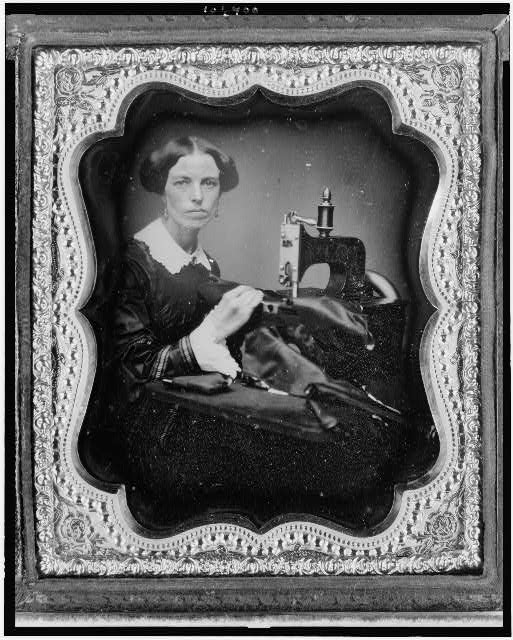
Today's public domain photo: an 1853 "occupational daguerreotype" of a seamstress, part of a PD collection, "America's First Look into the Camera: Daguerreotype Portraits and Views, 1839-1864."
Dear Rich: How do I add a copyright notice to a digital photo? I don't want a watermark or anything that appears on the image. If I embed it, is it still valid? Wow, The Dear Rich Staff loved working on Photo Week and we can't believe it's already over. Look for more exciting theme weeks soon.
Right, you had a question. A valid copyright notice is one that should be applied on all visually perceptible copies in a manner that, according to the Copyright Office, "gives reasonable notice of copyright." The notice should be permanently legible to an ordinary user of the work under normal conditions of use and should not be concealed from view upon reasonable examination. (Also, keep in mind that since March 1, 1989, copyright notice is not required on published photographs. Before that date, you could lose copyright if it was left off published copies.)
If it's not required, what good is notice? Notice serves a couple of purposes: it alerts everyone as to your copyright, and it prevents someone from ripping off your photo and later claiming they didn't know it was protected (an "innocent infringement").
So what works? If you're posting photos on a website, you can include notice on each photo -- usually accomplished by creating a "copyright notice layer" in Photoshop (and flattening a version of the image) before posting. That pre-flattened layer can be easily removed from the photo in the event you license it. Alternatively, you can include a notice near the photo or on a separate page like this.
What about metadata? A copyright notice that is included in a photo's metadata -- information that travels with the photo file but is not visible when looking at the photo -- probably does not provide valid notice since it's not visually perceptible when looking at the photo. However, we recommend that you include that information in your photo file (or using an invisible digital watermark) as that can sometimes be the key to proving infringement. (We explain how to do it below.) To include it in your metadata, you need to save copyright notice with your photo file. If you're using Photoshop (or probably any other photo editing program), you can enter metadata by going to File Info, or File Properties, (depending on your version) and entering the information as shown below. Photoshop even allows you to link to a web page where you can provide more information about copyright ownership.
Today's public domain photo: an 1853 "occupational daguerreotype" of a seamstress, part of a PD collection, "America's First Look into the Camera: Daguerreotype Portraits and Views, 1839-1864."
Subscribe to:
Posts (Atom)